This post is an addendum to yesterday's post about the General Assembly's decision concerning the ordination of ministers in civil partnerships.
It has been suggested elsewhere, something I forgot to mention in this original post. The structure of the proposal, which the General Assembly agreed, sits very uncomfortably with Presbyterianism. Matters of doctrine are intended to be able to be matters for the General Assembly to determine from time to time, within certain constraints. As a caveat to this, there is an acceptance that ordained ministers may personally dissent on matters which "do not enter into the substance of faith". But acting openly contrary to doctrine adopted and declared by the General Assembly is another thing altogether. The premise of presbyterianism is that once decisions on doctrine have been made, that church courts are to abide by them, even if those composing them disagree with the principles of the relevant doctrine.
What the Church of Scotland has adopted is a proposal which runs counter to the very idea of presbyterian governance as opposed simply to a principle of far looser congregationalism. It is, quite simply, not the same thing "not to have a doctrine" on same-sex relationships, and to have a doctrine with which congregations can disagree and are specifically empowered to act without consequence in direct contravention thereto. Leaving aside the practical differences between the liberal 2A proposal and the traditionalist compromise (2D) this was the essential theological divide between those two propositions. 2A said that the Church should not have a doctrine proclaiming "God's word" to be against same-sex relationships, whereas 2D said that the church SHOULD have such a doctrine but that certain congregations should be able to ignore it. This forms part of the very legitimate dissatisfaction liberals have with this proposal: the symbolic message, even if these proposals go to plan, and congregations can appoint gay clergy free from fear of reproach of Presbytery or higher courts, is that same sex relationships are assumed by the Church to be wrong.
In pushing through 2D, what the so-called traditionalist wing of the Church of Scotland have done, far from protecting the historical institutions and norms of the Kirk, is to erode part of the defining features of presbyterian governance and the relationship between its hierarchy of courts and the determination of doctrine. The average parishioner, and dare I say it, the average clergyman these days, probably does not care much for formal structures and is more concerned about the substantive debates that take place, across yet within most denominations, about theological issues. Yet one is minded of the history and premises behind the Kirk's form of governance and why it exists as a distinct denomination, and why other Presbyterian churches have emulated that approach. The traditionalist motion has, even if unintentionally, attacked presbyterianism, and undermined what "doctrine" actually means in that context.
Dr Thomas Chalmers was the leader of the evangelicals who left the Church of Scotland to form the Free Church in 1843 over what he saw as a "vitiated establishment". He believed at that time that presbyterian establishment had been undermined by the state intervening to let landlords appoint ministers contrary to the wishes of their congregations. There is perhaps an amusing irony that the Church of Scotland has come full circle, and on a question of who may ordain whom to serve in particular congregations, but with the sides reversed! For today it is the evangelicals, not the moderates, who are showing less integrity for the essence of a presbyterian polity. It is they who seek a fudged compromise to preserve a conservative 'establishment'. Meanwhile it is the liberals who articulated the most constitutionally honest option, which would have preserved the fundamentals of presbyterian polity, and which would have more honestly reflected the reality of the Church of Scotland's organised polity. The body of the Kirk, in reality, no longer considers homosexual relationships to be doctrinally unacceptable. That formal position was already becoming untenable given the fundamental disagreement between "traditionalists" and "revisionists". At best, it could only intellectually be considered a matter that some considered immoral and others did not, but which was in no sense susbtantially considered to be at the heart of the substance of faith held across the Kirk's spectrum.
The Kirk's new status quo, propagated by self-described traditionalists, manages to protect neither the intellectual integrity of doctrine, nor the unique governance of the Church of Scotland. If Dr Chalmers had been of this age, he may yet have still been against an open interpretation of scripture that made no assumptions about the morality of same-sex relationships. Yet he would surely also have been deeply disturbed at what the Church has had to become to avoid repeating a split like the one he led himself. This agnostic, brought up in the Church of Scotland (by very liberal ministers for parents), would respectfully suggest that presbyterianism may have over-reached its elastic limit with this compromise.

Tuesday, 21 May 2013


Monday, 20 May 2013
Church of Scotland - Religious progress one fudge at a time
 |
| The General Assembly crawled to consensus |
There was the "revisionist" proposal (2A), which would have (subject to ratification by a majority of Presbyteries, and then the General Assembly of 2014) enabled ministers who were in civil partnerships to be ordained and to serve as ministers, but to permit individual congregations formally to opt-out of calling ministers to their charge in such relationships on the grounds of their "active" sexuality, and to excuse other ministers in the same Presbytery from taking positive steps to sustain the call. Put simply, it would have ended both the doctrinal and the practical impediment to the ordination of those in legally recognised same-sex relationships.
The "traditional" option (2B), would re-affirm the Church's historical doctrine holding homosexual relationships to be contrary to scripture and thus, by extension, formally to make it a disciplinary matter and a bar to ordination as a minister, for those in civil partnerships.
In addition to this, two further alternatives were put forward. A hyper-liberal position (2C), later withdrawn, would have effectively dropped the requirement for same-sex couples to be in a civil partnership. There was the suggestion that this would have created an inconsistency with the Church's more general teachings and requirements placed upon heterosexual ministers, for whom it is a disciplinary matter to have a sexual relationship with someone outside of marriage. A final alternative (2D) proposed that the doctrinal opposition to same-sex relationships be retained, but that individual congregations would be permitted to opt-in to recruiting ministers in same-sex couples without facing disciplinary action from Presbytery.
That final motion was proposed by members of the traditionalist wing of the Church of Scotland, no doubt mindful of the potential of a strongly liberal vote to split the Kirk, and perhaps fearing that the 2B proposal was unlikely to succeed at all. In the end, 2D was adopted comprehensively by the General Assembly, with the 2B proposal losing comprehensively at the first ballot, and 2D trumping 2A fairly comfortably on the second. It certainly seems to be the case that some liberals crowded around the 2D proposal as a consensus option.
The Kirk formally remains critical of same-sex relationships, and has pursued what many will see as a classic fudge, the like of which the Kirk has become all too familiar with. Moreover, the 2D proposal will facilitate ordination and calling of ministers in civil partnerships at least a year later than planned. Because the motion was submitted so late, there is not yet a legal framework onto which to map the proposal to make it compatible with church and civil law (especially employment law and Art 8 ECHR); that has been left to the Legal Questions Committee to address at the next General Assembly in 2014. There will then be the need to pass that proposal, if approved, by a majority of Presbyteries in 2014-15, and the General Assembly to approve it again in 2015, under the terms of the Barrier Act. It is a piece of Church legislation that safeguards against unintended and radical departures from established doctrine, worship, discipline and governance.
Had 2A have passed, it would have meant its set of proposals were in force after the 2014. Many liberal Christians will rightly be critical of what has been decided, in that it fudges questions of doctrine instead of unambiguously promulgating a message of equality and inclusivity, and because 2D represents a delay. It is even possible that at the next General Assembly, the whole principles of the debate will be re-opened and disputed, even if the Legal Questions Committee report is tightly drafted. However, it is at least arguable that 2D is more likely to be approved by conservative Presbyteries, especially in the Highlands and Islands, given that the motion was on the initiative of the more evangelical wing. As a proposal it was specifically designed to prevent a split in the Church, and if it succeeds, it will achieve many of the practical aims of long-time liberal campaigners.
There remain considerable problems with the new compromise, including potential fault-lines in linked charges where one congregation seeks to opt-out of default Kirk doctrine and another does not. Moreover, it creates a conservative assumption that congregations will not seek to depart from the traditionalist perspective.
The Kirk is, in many respects, still far behind the rest of Scottish society on questions of sexuality, including equal marriage. It faces a constant dilemma of trying to accommodate its position as a "national" church with views at least as divergent as in any other denomination around the globe. Though it has a habit for innovative solutions to its internal conflicts, from the "spiritual independence" of the Church of Scotland Act 1921 to the theological commission itself, it does suggest a compromise that all will accept, but none will be especially pleased about. In much the same way as equal rights campaigners considered civil partnerships themselves progress, but an inadequate and awkward half-way house, so too that is what the Church of Scotland has done today. Hard though it is for liberals to accept, sometimes social progress in our institutions come not by great strides forward, but one fudge after another.
Wednesday, 1 May 2013
The million groat question - why the currency matters
"The referendum isn't about party politics"
A common refrain from both campaign teams in the independence referendum. Usually as soon as it's inconvenient for Better Together to get tarred by the record in government and policies of the three main Westminster parties, and by Yes Scotland whenever they're tarred by the SNP's record at Holyrood or their policies. Of course, it's not illegitimate for them to do this for the most part. A good referendum which debates this issue properly would try to dissociate it as much as possible from party-politics, albeit that's probably politically not viable in the quite hostile environment of Scottish politics. When the UK had the referendum on the EEC, there were multiple campaign groups and the issue was dealt with on its own merits rather than through the prism of inter-party disputes (albeit it did expose intra-party ones!). Moreover, there will be good arguments for independence and for the union on all regular sides of political divides: left versus right, liberal versus authoritarian, progressive versus conservative.
Where this is not true, however, is in respect of questions of transition and the mechanics of setting up an independent Scotland. These issues ought not, in the long-run, to affect Scotland's ability to be prosperous and broadly to hold its own in the global market and community. But they are important in making sure we set-up an independent Scotland on the strongest footing possible. A good referendum is one which pits the strongest arguments for a reformed British state against the strongest, most thought through vision for setting up an independent Scotland.
The sovereign state has become a far more complex beast than when self-determination first came in-vogue in the aftermath of WWI, and even since the fall of the Soviet Union. States do exist in a global market, where wealth flows more freely and where decisions are made by reference to multi-national organisations. I don't wish to dwell too much on the latter (perhaps for another post) but understanding economics in a global perspective is critical to articulating a coherent vision for an independent Scotland.
SNP matter more than YesScotland with this question
The SNP have said (at least since the Eurozone crisis) that their intention with the currency is to retain the use of the pound (£), the GBP, and to be part of a currency union with the rest of the UK. Note, of course, that there is no pre-existing provision in UK or international law that provides "independence events" (call it a secession, a separation, whatever) lead to currency being shared in such an arrangement. There is a heavily entrenched norm that sovereign states have the right to issue currency, and to delegate that power to bodies as they see fit (whether domestically by a central bank or to an international organisation as with the Euro). In practice, currency is issued by sovereign states or quasi-sovereign states as the forbearance of a sovereign state. It will, therefore, have to be something that is negotiated if it is to exist. But who negotiates? In whose interest do they act?
There seems to be an implicit understanding that the Scottish Government, or some related delegation, will represent Scotland in any domestic negotiations, and that some sort of UK Government derived delegation will represent the interests of rUK. This means that the fate of the currency from 2016, in the event of a yes vote, depends on these two groups agreeing something. As such, it really doesn't especially matter what YesScotland thinks about the currency. Any long-term decisions about whether we join the Euro, the pound, or another currency union, or have our own currency, would ultimately fall to future political debate, and there is nothing wrong with those on either side disagreeing with one another about what those long-term trends should be, whether within the UK or in an independent Scotland.
But with an independence event, the situation is different. When currency is issued based on the exercise of a sovereign right, and you are looking to create a new sovereign state, there has to be an explicit statement about what happens to that sovereign power. The interim arrangements matter, therefore the opinions of the respective prospective negotiators matters, in facilitating the situation on Day 1 of our brave new world.
The UK Government came out last week and said that they did not believe a currency union would be an especially viable proposition, and that it may be contrary to the interests of rUK to agree to sharing this sovereignty, at least without stringent fiscal controls. They are perhaps weary of the effect that fiscal divergence within a currency union, of which the Euro is far from the first example. You can agree or disagree about whether their fears are founded, and whether they have ulterior motives to unsettle the Yes campaign by being deliberately unconstructive, but the message here is that they are not prepared to share sovereign power in this way with an independent Scotland. And the Scottish Government/SNP/Scotland can't make them do that, either.
So even if a currency union is the SNP's preference, they can't just shout about the benefits of such a union (such as Scottish oil, drinks and renewable energy exports being positive to the balance of payments). They have to accept that such an arrangement is contingent on an agreement being reached, and to acknowledge that, in the absence of such an agreement, there has to be a contingency plan to facilitate an independence settlement, which does not depend upon Scotland being able to agree something substantial with the UK.
The alternatives to currency union
There are a number of options here, and they all need carefully considered.
1. Using the pound unilaterally
This isn't unprecedented: many countries use the US Dollar and the Euro unilaterally, for ease of trade with regional and/or global partners and because a local currency would be too weak and vulnerable to speculation. The drawbacks are that we would have zero control over monetary policy, which would be set by the rUK central bank, the Bank of England, and we would lack our own lender of last resort. This significantly limits the fiscal options that we can pursue in an independent Scotland, as we could not compensate with other "economic levers" (to borrow part of the SNP's popular narrative).
As a very superficial aside, such a situation would not protect "Scottish banknotes", as the right to issue those notes would depend upon rUK law surrounding the relationship between the Bank of England and those having the right to print currency. RBS, HBOS and Clydesdale might well continue their arrangements of depositing Bank of England notes in lieu of the notes they print for circulation in Scotland, but such an agreement is out of the hands of any independent Scotland's government.
2. Peg the Groat
Another option is to have our own currency, but to peg it to the pound, making it exchangeable at par. Some currencies already do this: for instance the Isle Of Man holds a large amount of Bank of England notes with its own central bank (as an indirect form of "reserve"), and issues the same amount of Manx notes. Note that this option also gives Scotland no real control over its monetary policy, thus by extension constrains its fiscal policy, as it has to maintain its reserve to notes ratio. The premise that we maintain something, perhaps called the (Scots) pound, freely exchangeable at par value with the currency used by the rUK part of the British isles, assumes that we constrain significant aspects of fiscal and monetary freedom, the very powers that are at the core of a lot of the "prosperity" arguments made by those in favour of independence. Denmark sort-of pegs its currency to the Euro, within a defined range, and relies on a mixed set of deposits in its central bank, that allow it to fluctuate minimally where circumstances require. This has the benefit of stability for economic planning, and encourages its economy to stay reasonably convergent with the Eurozone as a whole, but at the expense of full fiscal and monetary freedom.
3. Float the Groat
The final option is that we have our own currency and make no interim commitment to peg it to the pound. We would therefore have full control over our monetary and fiscal policy. The down-side to this is that currencies which float may prove a practical inhibitor to trade with the rest of the UK, as the volume of transactions might decrease a little.
In both the second and the third options, there would have to be some sort of transitional period facilitating the introduction of a new currency side-by-side. Some sort of fiscal controls would also have to be put in place during that period, in Scotland, to ensure that there isn't any capital flight. This, to my mind, is exactly what the period between the referendum and independence day should be for. Shadow institutions, including a central bank that holds deposits, whether of Bank of England notes, or another reserve (Scotland would be negotiating a pro-rata share of UK assets including value equal to reserves of (e.g.) gold kept in the Bank of England as security against the issue of GBP).
Since a division of assets will have to be agreed anyway in advance of independence, it seems to me to make more sense to sort-out the structural issues with the currency at that point, and to make sure that as few issues as possible require consent from a (reluctant) rUK negotiating team. It is clear they do not want a currency union, and all that having a currency union means is that if we change our mind later down the line we have to facilitate a transition to a different currency anyway. The Czechs and Slovaks found within a solitary month that their currency union was not viable, and had to decouple from one another as a result. You will probably find that the UK, if it didn't want to share a currency union, would seek to reduce the physical amount of reserves in the Bank of England, to prevent the value of the pound suddenly jumping as Bank of England notes fell out of circulation in Scotland. By presenting the issue as a question of simple asset division, it is less likely that rUK would object to Scotland claiming "its share" to set up its own currency.
Why you should give a damn
The bigger point here is that the SNP have tangled themselves up in knots over this issue. Their government is likely to be negotiating on Scotland's behalf in trying to settle these issues. We should be concerned that their attitude towards this is not to make clear their plan and their contingencies, and to spell out what "keeping the pound" actually means and what the alternatives would mean, rather to fall into the trap of lazy politicking about Better Together talking Scotland down. They have form for this type of siege mentality overriding what is in essence sensible policy.
Perhaps most importantly, their policy of currency union undermines some of the strongest economic arguments for independence. Far from giving us the fiscal levers to make our own decisions, a currency union shackles us to, if anything, more stringent fiscal demands than some proposals like DevoMax, where at least there would be in-built fiscal transfer mechanisms to cope with disparities. In a currency union in particular where one party would almost certainly court significantly disproportionate influence, the terms of the fiscal pact they'd have to agree would not be even that enjoyed by stable and strong Eurozone countries. And actually, a currency union expends more political capital than many of the practical alternatives. It probably makes sense to look to peg a new currency to the pound for a couple of years, to satisfy the markets that an independent Scotland would be fiscally trustworthy and therefore to facilitate a favourable environment in which bonds could be issued internationally. But we don't need a currency union to do that. We don't need a currency union to have a freely exchangeable currency at par to the rest of the Union. We can do this ourselves.
We can do this ourselves. It's the most compelling message the independence camp has to articulate if it is to win. And the SNP are undermining it. Their approach to this question is half-baked and half-hearted. They are afraid of arguing the strongest case because they aren't confident enough in their own ability to argue that independence is about a break with the status quo. They want to make it look as similar to our way of life as it is now: all of the benefits but no squaring of the circle of how we get there. There are significant opportunities that accompany the risks of independence. But many won't believe us about the opportunities if we aren't completely transparent about the risks and what steps we plan to take to mitigate them.
The currency question won't stop people like me who have already decided they're voting yes from continuing to do so. What it will do, though, is cement perceptions that the case for independence is inadequately thought through, especially for neutrals and pro-union voices and particularly for those who have come to associate independence and the Yes campaign with "the SNP". This is one of a handful of situations where what the SNP believe matters for an independent Scotland is actually relevant to the wider debate. By having a half-hearted answer to this question, it creates a semblance of a regime which is a shambles. And for a party whose raison-d'etre is Scottish independence, not to have discussed these issues in detail and to have this information ready for the public is negligent. It suggests they don't know what they're talking about, and I don't trust them to play Scotland's hand at its strongest. Whether we like it or not, competence will play a part in swaying people's views in the referendum. Salmond's party's bluster on this can take them only so far.
 |
| "Don't want one of your bastard English pounds!" |
Where this is not true, however, is in respect of questions of transition and the mechanics of setting up an independent Scotland. These issues ought not, in the long-run, to affect Scotland's ability to be prosperous and broadly to hold its own in the global market and community. But they are important in making sure we set-up an independent Scotland on the strongest footing possible. A good referendum is one which pits the strongest arguments for a reformed British state against the strongest, most thought through vision for setting up an independent Scotland.
The sovereign state has become a far more complex beast than when self-determination first came in-vogue in the aftermath of WWI, and even since the fall of the Soviet Union. States do exist in a global market, where wealth flows more freely and where decisions are made by reference to multi-national organisations. I don't wish to dwell too much on the latter (perhaps for another post) but understanding economics in a global perspective is critical to articulating a coherent vision for an independent Scotland.
SNP matter more than YesScotland with this question
The SNP have said (at least since the Eurozone crisis) that their intention with the currency is to retain the use of the pound (£), the GBP, and to be part of a currency union with the rest of the UK. Note, of course, that there is no pre-existing provision in UK or international law that provides "independence events" (call it a secession, a separation, whatever) lead to currency being shared in such an arrangement. There is a heavily entrenched norm that sovereign states have the right to issue currency, and to delegate that power to bodies as they see fit (whether domestically by a central bank or to an international organisation as with the Euro). In practice, currency is issued by sovereign states or quasi-sovereign states as the forbearance of a sovereign state. It will, therefore, have to be something that is negotiated if it is to exist. But who negotiates? In whose interest do they act?
There seems to be an implicit understanding that the Scottish Government, or some related delegation, will represent Scotland in any domestic negotiations, and that some sort of UK Government derived delegation will represent the interests of rUK. This means that the fate of the currency from 2016, in the event of a yes vote, depends on these two groups agreeing something. As such, it really doesn't especially matter what YesScotland thinks about the currency. Any long-term decisions about whether we join the Euro, the pound, or another currency union, or have our own currency, would ultimately fall to future political debate, and there is nothing wrong with those on either side disagreeing with one another about what those long-term trends should be, whether within the UK or in an independent Scotland.
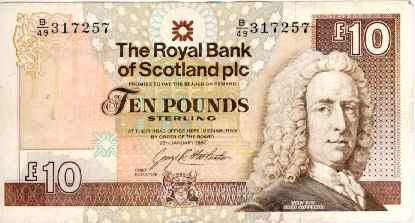 | |
| Our central bank could issue these if we keep BoE notes in reserve |
The UK Government came out last week and said that they did not believe a currency union would be an especially viable proposition, and that it may be contrary to the interests of rUK to agree to sharing this sovereignty, at least without stringent fiscal controls. They are perhaps weary of the effect that fiscal divergence within a currency union, of which the Euro is far from the first example. You can agree or disagree about whether their fears are founded, and whether they have ulterior motives to unsettle the Yes campaign by being deliberately unconstructive, but the message here is that they are not prepared to share sovereign power in this way with an independent Scotland. And the Scottish Government/SNP/Scotland can't make them do that, either.
So even if a currency union is the SNP's preference, they can't just shout about the benefits of such a union (such as Scottish oil, drinks and renewable energy exports being positive to the balance of payments). They have to accept that such an arrangement is contingent on an agreement being reached, and to acknowledge that, in the absence of such an agreement, there has to be a contingency plan to facilitate an independence settlement, which does not depend upon Scotland being able to agree something substantial with the UK.
The alternatives to currency union
There are a number of options here, and they all need carefully considered.
1. Using the pound unilaterally
This isn't unprecedented: many countries use the US Dollar and the Euro unilaterally, for ease of trade with regional and/or global partners and because a local currency would be too weak and vulnerable to speculation. The drawbacks are that we would have zero control over monetary policy, which would be set by the rUK central bank, the Bank of England, and we would lack our own lender of last resort. This significantly limits the fiscal options that we can pursue in an independent Scotland, as we could not compensate with other "economic levers" (to borrow part of the SNP's popular narrative).
As a very superficial aside, such a situation would not protect "Scottish banknotes", as the right to issue those notes would depend upon rUK law surrounding the relationship between the Bank of England and those having the right to print currency. RBS, HBOS and Clydesdale might well continue their arrangements of depositing Bank of England notes in lieu of the notes they print for circulation in Scotland, but such an agreement is out of the hands of any independent Scotland's government.
2. Peg the Groat
Another option is to have our own currency, but to peg it to the pound, making it exchangeable at par. Some currencies already do this: for instance the Isle Of Man holds a large amount of Bank of England notes with its own central bank (as an indirect form of "reserve"), and issues the same amount of Manx notes. Note that this option also gives Scotland no real control over its monetary policy, thus by extension constrains its fiscal policy, as it has to maintain its reserve to notes ratio. The premise that we maintain something, perhaps called the (Scots) pound, freely exchangeable at par value with the currency used by the rUK part of the British isles, assumes that we constrain significant aspects of fiscal and monetary freedom, the very powers that are at the core of a lot of the "prosperity" arguments made by those in favour of independence. Denmark sort-of pegs its currency to the Euro, within a defined range, and relies on a mixed set of deposits in its central bank, that allow it to fluctuate minimally where circumstances require. This has the benefit of stability for economic planning, and encourages its economy to stay reasonably convergent with the Eurozone as a whole, but at the expense of full fiscal and monetary freedom.
3. Float the Groat
The final option is that we have our own currency and make no interim commitment to peg it to the pound. We would therefore have full control over our monetary and fiscal policy. The down-side to this is that currencies which float may prove a practical inhibitor to trade with the rest of the UK, as the volume of transactions might decrease a little.
In both the second and the third options, there would have to be some sort of transitional period facilitating the introduction of a new currency side-by-side. Some sort of fiscal controls would also have to be put in place during that period, in Scotland, to ensure that there isn't any capital flight. This, to my mind, is exactly what the period between the referendum and independence day should be for. Shadow institutions, including a central bank that holds deposits, whether of Bank of England notes, or another reserve (Scotland would be negotiating a pro-rata share of UK assets including value equal to reserves of (e.g.) gold kept in the Bank of England as security against the issue of GBP).
Since a division of assets will have to be agreed anyway in advance of independence, it seems to me to make more sense to sort-out the structural issues with the currency at that point, and to make sure that as few issues as possible require consent from a (reluctant) rUK negotiating team. It is clear they do not want a currency union, and all that having a currency union means is that if we change our mind later down the line we have to facilitate a transition to a different currency anyway. The Czechs and Slovaks found within a solitary month that their currency union was not viable, and had to decouple from one another as a result. You will probably find that the UK, if it didn't want to share a currency union, would seek to reduce the physical amount of reserves in the Bank of England, to prevent the value of the pound suddenly jumping as Bank of England notes fell out of circulation in Scotland. By presenting the issue as a question of simple asset division, it is less likely that rUK would object to Scotland claiming "its share" to set up its own currency.
Why you should give a damn
The bigger point here is that the SNP have tangled themselves up in knots over this issue. Their government is likely to be negotiating on Scotland's behalf in trying to settle these issues. We should be concerned that their attitude towards this is not to make clear their plan and their contingencies, and to spell out what "keeping the pound" actually means and what the alternatives would mean, rather to fall into the trap of lazy politicking about Better Together talking Scotland down. They have form for this type of siege mentality overriding what is in essence sensible policy.
Perhaps most importantly, their policy of currency union undermines some of the strongest economic arguments for independence. Far from giving us the fiscal levers to make our own decisions, a currency union shackles us to, if anything, more stringent fiscal demands than some proposals like DevoMax, where at least there would be in-built fiscal transfer mechanisms to cope with disparities. In a currency union in particular where one party would almost certainly court significantly disproportionate influence, the terms of the fiscal pact they'd have to agree would not be even that enjoyed by stable and strong Eurozone countries. And actually, a currency union expends more political capital than many of the practical alternatives. It probably makes sense to look to peg a new currency to the pound for a couple of years, to satisfy the markets that an independent Scotland would be fiscally trustworthy and therefore to facilitate a favourable environment in which bonds could be issued internationally. But we don't need a currency union to do that. We don't need a currency union to have a freely exchangeable currency at par to the rest of the Union. We can do this ourselves.
 |
| Stop being a fearty, Eck! Use all the fiscal levers. |
The currency question won't stop people like me who have already decided they're voting yes from continuing to do so. What it will do, though, is cement perceptions that the case for independence is inadequately thought through, especially for neutrals and pro-union voices and particularly for those who have come to associate independence and the Yes campaign with "the SNP". This is one of a handful of situations where what the SNP believe matters for an independent Scotland is actually relevant to the wider debate. By having a half-hearted answer to this question, it creates a semblance of a regime which is a shambles. And for a party whose raison-d'etre is Scottish independence, not to have discussed these issues in detail and to have this information ready for the public is negligent. It suggests they don't know what they're talking about, and I don't trust them to play Scotland's hand at its strongest. Whether we like it or not, competence will play a part in swaying people's views in the referendum. Salmond's party's bluster on this can take them only so far.
Thursday, 25 April 2013
Scottish Independence, the Kirk, and the Constitution
 |
| The Kirk has its say on Scotland's Future |
I should disclose at this point, that I have a declarable interest in this particular issue. My honours law dissertation this year explored the historical relationship between church and state in Scotland. As a part of that, I addressed some of the connected issues of that relationship to the British constitution and Scottish independence. My father sits on the Legal Questions Committee of the Kirk, and on becoming aware of this report, I asked the joint committee if I may have advanced sight of it. I received the final draft in late February and it proved very useful. I wish to thank in particular Ewan Aitken, the Secretary of the Church and Society Committee, for being so helpful in this regard.
This is an important document for several reasons, and explains why the independence question is a lot more complicated than what is passing for today's political debate. There are several dimensions to this question about how we rule ourselves and how we are governed.
Where we are
Perhaps crucially, it reminds us where we are, constitutionally speaking, in Scotland. We have a (sort-of) established church, protected by the Treaty of Union. Indeed, the protection of Scotland's distinctive "national" Church from that of England is essential to the historical context of the Union, the constitutional framework within which we operate today, and around which devolution has circumnavigated. Though the Church of Scotland and the British state are, for most practical purposes, autonomous entities from one another, there remains a symbolic relationship between them. The Church of Scotland Act, and the "Declaratory Articles" of the Church of Scotland, define mutual duties and spheres of autonomy between them. The monarch must take an oath to protect the Presbyterian Church in Scotland, and does so before the Privy Council after his or her formal coronation ceremony.
The Scottish understanding of Establishment was always different from what we recognise with the Church of England. Our Reformation took a very different path from that pursued by Henry VIII and Elizabeth, whereby there was a relationship of coexistence between church and state, rather than subordination of the Church to the state by the monarch. The Kirk has no ecclesiastical hierarchy; rather a Presbyterian polity, and does not have representation in the House of Lords. Crucially, it was seen to be "spiritually independent", something it values to this day.
The difference in the two church-state relationships is perhaps most poetically articulated by C16th theologian Andrew Melville. He issued a rebuke to King James VI, reminding him:
"Sirrah, ye are God's silly vassal; there are two kings and two kingdoms in Scotland: there is king James, the head of the commonwealth; and there is Christ Jesus, the king of the Church, whose subject James the Sixth is, and of whose kingdom he is not a king, not a lord, not a head, but a member."
Where we're going
Scotland's media have focused on the comments the report has made about the future of the monarchy. The SNP's proposal for independence, surprisingly (and disappointingly) for some, involves the retention of the monarchy, in the form of a King/Queen of Scots, performing a largely ceremonial role as head of state. The precise approach to implementing such a system remains to be clarified. This goes to the heart of what we mean by independence for Scotland and what the implications are for the rest of the United Kingdom.
The remainder of the UK would surely not be the restoration of the Kingdom of England. If we assume that Northern Ireland wishes to remain a part of the Union, we must take into account the fact that it represents the remaining territory of an historically distinct crown (that of the Kingdom of Ireland) which ultimately merged not with the Kingdom of England, but the Kingdom of Great Britain. No doubt there would also be some disquiet from those in Wales, who would contest being lumped in with the English crown even if that were historically true.
What this means is that the monarchies we would have to have after Scottish independence, in order to implement the SNP's model, would either be two completely newly constituted ones, or else we treat the Scottish one as having no continuity with its pre-1707 crown, and the rUK one simply losing territorial application. In either case, it means that the Scottish crown is something new, and whose role we will have to define carefully within the new constitutional framework. A constitution will have difficulty justifying, for example, a renewal of the Royal Prerogative, but it will have to provide alternative rules for how power should be exercised. We will have to reach some sort of arrangement about the line of succession, for instance: do we want to adopt the same rules as rUK? In particular, is there any need for us to retain the ban on Catholics from becoming our head of state, which the UK plans to retain under its latest reforms, even though the monarch may in future marry a Catholic?
These questions are more euphemistically raised within the paper. In particular, the Catholic question is described as a "sensitive ecumenical issue"! The way the Church of Scotland operates has changed significantly, even in the last 30-40 years. It has become far more open to working alongside other denominations, in worship and interaction with wider society. It seems to me that these matters need considered far more carefully than the relatively trivial question about whether there should be two separate coronations after independence. We should also ask whether the Church of Scotland should continue to be treated as a state-recognised denomination, rather than simply one which operates with the status as voluntaries (from Catholics, to Buddhists to other Presbyterians).
The justification for the two coronations was the notion that the monarch's oath to uphold the Presbyterian Kirk should be echoed in some way. This seems to me to be unnecessary, even if you were to keep the monarchy and an 'established' Church. The only reason that the monarch had such an oath in the first place following the Union with England, was to protect it against being turned into an Episcopalian or Anglican Church. There is no realistic prospect of the state interfering in the governance of the Church of Scotland in the 21st century, let alone a desire to impose a religion on the Scottish people at large.
Three Important Lessons
All this being said, I think there are three lessons we need to draw from this report and the broader issues of the Church of Scotland's relationship with the state, which matter considerably to the wider independence debate:
1. The role of faith groups in the state
If we are to involve faith representation in the constitution of Scotland, we need to be more imaginative than to adopt even the Scottish tradition of establishment. Scotland is more irreligious than ever before, and all large denominations are particularly struggling. Instead of privileging specific denominations with things like positions on local government education boards, for example, we should consider "faith-based-input" into state affairs being done on a more ecumenical platform. The organised religions of Scotland work closely with one another on many issues of practical significance (for example, they now consult one another regularly on how best to implement their legal duties like those with Disclosure Scotland in respect of children and vulnerable adults). Any constitutional exercise may wish to look at the work undertaken by the Scottish Inter-Faith Council and decide what, if any, formal avenues of input a similar such body should enjoy.
2. The role of civic society alongside the state
The Church of Scotland provides a model for engagement between state and civic society. The British conception of sovereignty, particularly of institutions, is very centralising and yet also very remote. If we are to encourage a new form of democratic engagement and to invogorate our civic institutions, it needs to come from an attitude of mutual respect by government for their spheres of influence. We should also look to close partnership between civic groups and the state in provision of "public goods" like education. This might reek of the rhetoric of David Cameron's dead duck, the "Big Society" but there is much to commend community action and to make good on the sense in Scotland of the "common weel". In much of the political opposition to what many see as "excessive" capitalism, there is a danger that Scotland loses its sense of society being something which can support itself without being subordinate to state activity. Democracy starts with community, and our political institutions will not always have the answers.
3. The importance of a clearly mapped constitutional process
We need to talk about the new constitution and we need to do it before the referendum. Even if it just means clearly outlining the process by which we will draw up our new constitution, we have to make sure that process is in place beforehand, and be clear what groups get to influence it and how. In particular, we absolutely do not want to have our constitution determined by whoever happens to comprise a political majority in our legislature at the time of independence. If a constitution is to be enduring, we have, at the very least, to seek a cross-political-party consensus before putting it to the people, and ideally we need to have some sort of input for civic society. Our constitution will set in motion the basis for a new way of doing things in Scotland, and we have to make sure everyone understands the terms of engagement in getting it right.
My politics is by instinct republican, but scarcely revolutionary. Though brought up in the Church of Scotland, I am irreligious. But even if Scotland is not the "Christian country" it once was, our religious organisations remain important to this broader debate about the kind of state we want to live in. To respond, we must first understand.
Wednesday, 27 March 2013
Just what is a constitution for, anyway?
Much has been made of the SNP's public plans for a written constitution to be formed in the event that Scotland becomes an independent state following the 2014 referendum. The quest for codification is something that has been, if put unkindly, a perpetual pet project of many a constitutional reformer (myself included). Hardly any states do not have some form of comprehensive document detailing the supreme or basic law of their state: the United Kingdom, New Zealand, Israel (sort of) and Saudi Arabia lack a central constitutional document setting out the bodies of state and what they may lawfully do.
I have long been in favour of the codification of the UK constitution. Though we have relied, historically, on the evolution of conventions and ad hoc solutions to constitutional conflict, it has left us with a patch-work of law, much of which is incoherent and inconsistent. We also have anarchronisms like the Royal Prerogative, which though largely exercised by government ministers these days, provides totally unaccountable powers used for malignant purposes. Even devolution is by its nature constitutionally conservative: minimalist in the way it changes the way the state operates. It is a politically, rather than a legally entrenched settlement, which relies on goodwill rather than institutional rigour to deliver its aims.
Constitutional introspection, though a risk, is also an opportunity. Properly revisiting the way you do governance provides an excellent chance to clean up the loose ends of a constitution, and to start anew in other respects. Iceland recently attempted to crowd-source its constitution. Though I think that's not a particularly good way to do it, some degree of consultation on the specifics, before having a referendum to ratify the constitution, would be a good way to go about it. One of the strongest arguments I think that exists for Scottish independence is that the call for a codified UK constitution has gained very little traction. It is symptomatic of the institutional aversion of the British state to radical all-encompassing reform of the way it governs. In that regard, independence presents an opportunity to have a serious discussion not just about how the central state runs itself, but also what kind of relationship it has with more local forms of power.
This is why I am so disappointed that the SNP have tried to turn the debate about the constitution into something it's not. A constitution is supposed, for the most part: to declare as lawful the existence of the different branches of the state (i.e. executive, legislature and judiciary); the extent and nature of their powers and who may limit them; and to enunciate the fundamental rights of the citizens, which the state is required to guarantee as a pre-requisite for its legitimacy to make sovereign acts on their behalf. A constitution does not exist to restrict the state on matters of broad policy as to how a state should allocate its resources. It is in that respect that talk of constitutionally protected state-funded University tuition and council houses for all is an absurdity.
These things should not be constitutional rights. There is significant debate about how we prioritise state funding, and what public services we expect people to contribute to in other ways. Now of course there is an emerging, particularly solidified consensus within the western developed world that there is a general moral right to education, and to a home, and states recognise broad duties to deliver the goals of these social aims. In education, our states legislate to provide primary education for all who seek it, increasingly secondary education is provided by the state out of general taxation, and there is a recognition that to leave people destitute is something that is not acceptable. But these are not the same kind of rights as the right not to be tortured, or the right to freedom of expression. These are delivered through substantive policies and extensive discussion about how and where to raise taxes and distribute government spending. You get the big discussions about whether benefits and services should be universal, or whether they should be means tested. You get questions in the NHS about whether we should fund a cancer drug or prescriptions. You get questions about whether we should build a new school, amalgamate existing ones and so forth. And yes, we get discussions about whether Universities and student support should be funded out of general taxation, or whether students should make a contribution in-lieu of that support.
Let's just assume for a moment that you buy into the idea that access to University can only be secured through full state funding and that it is an imperative (for various reasons why this is wrong, see elsewhere on this blog). How has this and other provision of "free" education more generally been delivered in society. By a constitutional guarantee? Of course not. It's been delivered by ordinary legislation. In the UK, school education was delivered by the Education Acts in both Scotland and England. Yes, the Republic of Ireland has a constitutional commitment to the provision of primary education. This is a direct importation of the substantive expectaitons of the international agreements many western states have signed up to. But no one is seriously saying that that constitutional provision is any causal link to the delivery of primary education in Ireland.
Why does its state provide secondary education if that isn't in the constitution? Why has virtually every modern western liberal democracy, even that market driven United States of America, provided primary and secondary education through state funding for all those who need it? Because it's about a political consensus about the broad way tax should be spent, and not a fundamental right. That's why. No one seriously suggests that the state is fundamentally illegitimate if it were to start charging for these things, but they might accuse it of being undemocratic and unrepresentative of the views consistently expressed by people at the ballot box. Other states that deliver state-funded university tuition do so without a constitutional amendment. Meanwhile, South Africa has a constitutional right to education. Yet millions remain illiterate and living in absolute poverty. It would be an absurdity if a court were to insist, by judicial diktat, that a state keep a particular school open or keep a particular course at University running and such-like, to the exclusion of being allowed to do other things with its budget to try to provide different kinds of education to other people. To borrow the title of Ted Heath's 1966 Tory Manifesto, "Actions, Not Words". That's how you satisfy socio-economic rights.
But now let's suppose that governments did consider themselves bound by this constitutional law. What does the fact it's a constitutional law, and not an ordinary law mean? It means that it's likely to be more difficult to repeal or to change. Constitutional provisions typically require some sort of special procedure to be overturned, unlike an ordinary Act of Parliament, with the effect that if the consensus changed, or someone who did not share this policy came to government, they would be prevented from implementing their own economic policies by a static spending commitment that they could not alter. What right do the SNP have to entrench their own policies into the very legitimacy of the Scottish state? One of the most strongly resonating messages of the YesScotland campaign is that independence is not just about the SNP. It's hard enough trying to convince Unionists that independence isn't an eternal fiefdom for Alex Salmond without his party making clear that it is their intention to impose his manifesto in the constitution if his party have control over the constitution. If we are to have a clean slate, that means being able to make these decisions as a country for ourselves. Independence is about having more control over our own affairs, not less, and placing unnecessary limits on the policy process makes us have less influence over our own affairs, and actually, less democratically accountable.
Moreover, the SNP policy doesn't even resemble what we understand as a right. It's a policy. It doesn't enshrine and encompass a general principle about education. Free tuition in Scotland applies to a very distinct and carefully defined category of person. It doesn't apply to non-EU international students and (at the moment) rest of UK students. It doesn't apply to students who have to resit years and can't get false-start funding. It doesn't apply to postgraduate students (as every lawyer and teacher will tell you!). It is a very specific commitment to fund the tuition fees of those who are accepted to their first undergraduate degree who are Scottish domiciled or an EU student. It doesn't go to the heart of a fundamental "human" right, because it doesn't apply to all humans. It doesn't encompass education generally because many courses that people get offered to become a part of on merit cannot afford the post-graduate costs. It doesn't encompass all courses, but specific ones approved by the state. If you don't meet their special criteria for what constitutes education, you don't get help. There is no general commitment to continuing access to universities for lifelong learning and personal development. This is a policy, based on finite resources. And that's fine. But its not a fundamental right and it doesn't deliver or guarantee a fundamental principle. Provision of things is different from, for example, the right to free expression. We have the right to speak out and to communicate, but the state doesn't give everyone a phone and a newspaper business. You don't have to be socialists or communists to believe in human rights, because they don't require specific provision of things by the state, except insofar as the state interferes with your rights in other ways.
But actually, what this shows is that the SNP want to make the independence debate about something it's not. It's not about whether you get more or less "free" stuff on independence. It's about taking responsibility for our own decisions. Their policy is hotly contested in respect of what it guarantees. As I've shown elsewhere on this blog, the continuing existence of maintenance loans, which are repaid under the same system as fees anyway, actually means education isn't even a free and accessible endeavour. For those who earn a career average salary of £28.5kpa in today's money, the Scottish student finance system actually requires you to pay more for your education than the English one does. If you believe in the principle of free education, you have to go the whole way and have the guts to return to maintenance grants. That means either finding the revenue to pay for it elsewhere, or cutting the number of people that go to University. The truth is that if your principle is fair access to all, a form of graduate contribution is likely to be the best way to facilitate more education and better education throughout Scotland, even if we are well off and raise more revenue in an independent Scotland than we do in the current UK situation.
You see, socio-economic rights are complex. They're about the art of the achievable and how best to manipulate the productivity of society (largely engendered by market capitalism) to pursue social goals without reaching unintended consequences. This is the same week as news reports show despite free tuition, Scotland consistently performs less well than England at getting kids from disadvantaged backgrounds into its Universities. Independence is about facing up to these questions and trusting the Scottish people to come up with the best, often very nuanced, answers. Political grandstanding about jam and honey is just the inversion of BetterTogether scaremongering about how we'll pay for everything. The best argument for independence is that Scotland can make these decisions for itself in a way that engages its people to a better extent than the United Kingdom can. It's not about the particular policies. So please. Stop talking about them.
I have long been in favour of the codification of the UK constitution. Though we have relied, historically, on the evolution of conventions and ad hoc solutions to constitutional conflict, it has left us with a patch-work of law, much of which is incoherent and inconsistent. We also have anarchronisms like the Royal Prerogative, which though largely exercised by government ministers these days, provides totally unaccountable powers used for malignant purposes. Even devolution is by its nature constitutionally conservative: minimalist in the way it changes the way the state operates. It is a politically, rather than a legally entrenched settlement, which relies on goodwill rather than institutional rigour to deliver its aims.
Constitutional introspection, though a risk, is also an opportunity. Properly revisiting the way you do governance provides an excellent chance to clean up the loose ends of a constitution, and to start anew in other respects. Iceland recently attempted to crowd-source its constitution. Though I think that's not a particularly good way to do it, some degree of consultation on the specifics, before having a referendum to ratify the constitution, would be a good way to go about it. One of the strongest arguments I think that exists for Scottish independence is that the call for a codified UK constitution has gained very little traction. It is symptomatic of the institutional aversion of the British state to radical all-encompassing reform of the way it governs. In that regard, independence presents an opportunity to have a serious discussion not just about how the central state runs itself, but also what kind of relationship it has with more local forms of power.
This is why I am so disappointed that the SNP have tried to turn the debate about the constitution into something it's not. A constitution is supposed, for the most part: to declare as lawful the existence of the different branches of the state (i.e. executive, legislature and judiciary); the extent and nature of their powers and who may limit them; and to enunciate the fundamental rights of the citizens, which the state is required to guarantee as a pre-requisite for its legitimacy to make sovereign acts on their behalf. A constitution does not exist to restrict the state on matters of broad policy as to how a state should allocate its resources. It is in that respect that talk of constitutionally protected state-funded University tuition and council houses for all is an absurdity.
These things should not be constitutional rights. There is significant debate about how we prioritise state funding, and what public services we expect people to contribute to in other ways. Now of course there is an emerging, particularly solidified consensus within the western developed world that there is a general moral right to education, and to a home, and states recognise broad duties to deliver the goals of these social aims. In education, our states legislate to provide primary education for all who seek it, increasingly secondary education is provided by the state out of general taxation, and there is a recognition that to leave people destitute is something that is not acceptable. But these are not the same kind of rights as the right not to be tortured, or the right to freedom of expression. These are delivered through substantive policies and extensive discussion about how and where to raise taxes and distribute government spending. You get the big discussions about whether benefits and services should be universal, or whether they should be means tested. You get questions in the NHS about whether we should fund a cancer drug or prescriptions. You get questions about whether we should build a new school, amalgamate existing ones and so forth. And yes, we get discussions about whether Universities and student support should be funded out of general taxation, or whether students should make a contribution in-lieu of that support.
Let's just assume for a moment that you buy into the idea that access to University can only be secured through full state funding and that it is an imperative (for various reasons why this is wrong, see elsewhere on this blog). How has this and other provision of "free" education more generally been delivered in society. By a constitutional guarantee? Of course not. It's been delivered by ordinary legislation. In the UK, school education was delivered by the Education Acts in both Scotland and England. Yes, the Republic of Ireland has a constitutional commitment to the provision of primary education. This is a direct importation of the substantive expectaitons of the international agreements many western states have signed up to. But no one is seriously saying that that constitutional provision is any causal link to the delivery of primary education in Ireland.
Why does its state provide secondary education if that isn't in the constitution? Why has virtually every modern western liberal democracy, even that market driven United States of America, provided primary and secondary education through state funding for all those who need it? Because it's about a political consensus about the broad way tax should be spent, and not a fundamental right. That's why. No one seriously suggests that the state is fundamentally illegitimate if it were to start charging for these things, but they might accuse it of being undemocratic and unrepresentative of the views consistently expressed by people at the ballot box. Other states that deliver state-funded university tuition do so without a constitutional amendment. Meanwhile, South Africa has a constitutional right to education. Yet millions remain illiterate and living in absolute poverty. It would be an absurdity if a court were to insist, by judicial diktat, that a state keep a particular school open or keep a particular course at University running and such-like, to the exclusion of being allowed to do other things with its budget to try to provide different kinds of education to other people. To borrow the title of Ted Heath's 1966 Tory Manifesto, "Actions, Not Words". That's how you satisfy socio-economic rights.
But now let's suppose that governments did consider themselves bound by this constitutional law. What does the fact it's a constitutional law, and not an ordinary law mean? It means that it's likely to be more difficult to repeal or to change. Constitutional provisions typically require some sort of special procedure to be overturned, unlike an ordinary Act of Parliament, with the effect that if the consensus changed, or someone who did not share this policy came to government, they would be prevented from implementing their own economic policies by a static spending commitment that they could not alter. What right do the SNP have to entrench their own policies into the very legitimacy of the Scottish state? One of the most strongly resonating messages of the YesScotland campaign is that independence is not just about the SNP. It's hard enough trying to convince Unionists that independence isn't an eternal fiefdom for Alex Salmond without his party making clear that it is their intention to impose his manifesto in the constitution if his party have control over the constitution. If we are to have a clean slate, that means being able to make these decisions as a country for ourselves. Independence is about having more control over our own affairs, not less, and placing unnecessary limits on the policy process makes us have less influence over our own affairs, and actually, less democratically accountable.
Moreover, the SNP policy doesn't even resemble what we understand as a right. It's a policy. It doesn't enshrine and encompass a general principle about education. Free tuition in Scotland applies to a very distinct and carefully defined category of person. It doesn't apply to non-EU international students and (at the moment) rest of UK students. It doesn't apply to students who have to resit years and can't get false-start funding. It doesn't apply to postgraduate students (as every lawyer and teacher will tell you!). It is a very specific commitment to fund the tuition fees of those who are accepted to their first undergraduate degree who are Scottish domiciled or an EU student. It doesn't go to the heart of a fundamental "human" right, because it doesn't apply to all humans. It doesn't encompass education generally because many courses that people get offered to become a part of on merit cannot afford the post-graduate costs. It doesn't encompass all courses, but specific ones approved by the state. If you don't meet their special criteria for what constitutes education, you don't get help. There is no general commitment to continuing access to universities for lifelong learning and personal development. This is a policy, based on finite resources. And that's fine. But its not a fundamental right and it doesn't deliver or guarantee a fundamental principle. Provision of things is different from, for example, the right to free expression. We have the right to speak out and to communicate, but the state doesn't give everyone a phone and a newspaper business. You don't have to be socialists or communists to believe in human rights, because they don't require specific provision of things by the state, except insofar as the state interferes with your rights in other ways.
But actually, what this shows is that the SNP want to make the independence debate about something it's not. It's not about whether you get more or less "free" stuff on independence. It's about taking responsibility for our own decisions. Their policy is hotly contested in respect of what it guarantees. As I've shown elsewhere on this blog, the continuing existence of maintenance loans, which are repaid under the same system as fees anyway, actually means education isn't even a free and accessible endeavour. For those who earn a career average salary of £28.5kpa in today's money, the Scottish student finance system actually requires you to pay more for your education than the English one does. If you believe in the principle of free education, you have to go the whole way and have the guts to return to maintenance grants. That means either finding the revenue to pay for it elsewhere, or cutting the number of people that go to University. The truth is that if your principle is fair access to all, a form of graduate contribution is likely to be the best way to facilitate more education and better education throughout Scotland, even if we are well off and raise more revenue in an independent Scotland than we do in the current UK situation.
You see, socio-economic rights are complex. They're about the art of the achievable and how best to manipulate the productivity of society (largely engendered by market capitalism) to pursue social goals without reaching unintended consequences. This is the same week as news reports show despite free tuition, Scotland consistently performs less well than England at getting kids from disadvantaged backgrounds into its Universities. Independence is about facing up to these questions and trusting the Scottish people to come up with the best, often very nuanced, answers. Political grandstanding about jam and honey is just the inversion of BetterTogether scaremongering about how we'll pay for everything. The best argument for independence is that Scotland can make these decisions for itself in a way that engages its people to a better extent than the United Kingdom can. It's not about the particular policies. So please. Stop talking about them.
Subscribe to:
Posts (Atom)