Showing posts with label tim farron. Show all posts

Monday, 20 July 2015

Piercing the Secular Veil

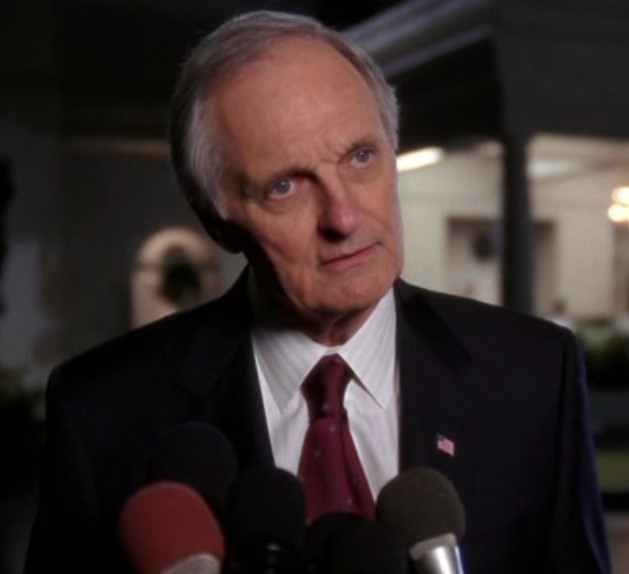
There is an episode of the American Presidential drama, The West Wing, called "In God We Trust". It follows the challenges of Arnold Vinick, a liberal Republican, who finds himself in hot water with the religious right of his party, particularly on the question of his stance on abortion. Arnie's religiosity had very noticeably faded with the passing years, but just as in the real world of American politics, the role religion had in public life remained every bit as potent. It emerges, when Reverend Butler, one of his Republican primary candidates invites him to come to his church to pray for divine wisdom, that Vinick had not attended church for quite some time.

Facing down the pressures from within his own party, Vinick eventually provides a robust, if unpopular, response to the media storm that ensues. Responding to those that seek to shoehorn religious debate into politics, he ends a press interview with the totemic rebuke:
"I don't see how we can have a separation of church and state in this government if you have to pass a religious test to get in this government.

So every day until the end of this campaign, I will answer any question on government. But if you have a question on religion, then please, go to church."

As a secular liberal, I have a significant and instinctive affinity with Vinick's sentiment. It feels right that religion should, for the most part, be a private matter, and not something that the state is concerned with. I am also weary of any person or group which seeks to use organised religion for explicitly political purposes.

The American experience is, in many respects, the total reverse of the British one. Despite lacking a separation of church and state, there is a much more limited role for religion in political life. Far from being an electoral asset, publicly professing religious belief is arguably a hindrance to politicians on left and right alike. When Alastair Campbell said of the Blair government that "we don't do God" it was a reflection of British public life. Religion is seen as an unwelcome distraction from broader social issues which transcend the theistic loyalties of the people on this island.

It is against that culture that the storm in the Liberal teacup brewed this week. Tim Farron, the new party leader, is openly a committed, born-again, evangelical Christian, and has been since early on in his adult life. Against a tide of increasing irreligion, and in a political environment where religion is increasingly seen as the preserve of the conservative right, this makes him markedly atypical.

Any secular liberal would see no problem with Tim being a Christian and the leader of a Liberal party. Both of my parents, who are Church of Scotland Ministers, recently joined the Liberal Democrats. The late Charles Kennedy was Catholic. Christianity and Liberalism are not incompatible. The two can exist perfectly constructively. Anyone who suggests otherwise probably doesn't understand secularism or liberalism, and the toleration that binds them together.

There ought not even to be a problem with Tim being an evangelical Christian. Certainly it is easier to reconcile theological liberalism with political liberalism, reading religious texts more as historical documents reflective of the morality of their time than purely and unwaveringly the universal diktats of the relevant deity. Evangelical, or more literalist scriptural interpretation, is more hard-edged in its implications for personal morality, but crucially it does not, in and of itself, necessitate the imposition of one's personal morality upon others. An evangelical Christian might insist on abstinence before marriage, and might privately disapprove of those who do not, but few would call for criminalisation or insist that the rest of society ought in some other way to be held to that moral standard.

Secular liberalism does provide a firewall, or a demarcation, that makes it possible hold yourself to what you see as a "higher" moral standard than you do others. Views can be held privately, and are not "illiberal" except insofar as they impinge upon the freedom of others to do the same. It's harm principle 101.

Where things get difficult is when this firewall breaks-down. Many liberals would like to think that this firewall is impregnable. If people who believe same sex relations are sinful or immoral nonetheless treat those in those relationships equally with others, the argument goes, their liberal credentials are unscathed.

The reality is somewhat more complicated. Religion does not manifest itself as a purely private endeavour. The nature of organised religion, in particular, means that theological views gain a social power. It is this social power that often facilitates, even if unintentionally, the stigma and otherisation and discrimination against certain minority groups, including the LGBT+ community. It also does a great deal of good. Much of th einfrastructure of philanthropy and charitable work is sustained and supported by religious groups, as is the cause of vulnerable and persecuted groups across the world, who get precious little attention elsewhere. The social power of religion and faith is not only negative, but those invoking it have to be mindful that it is a double-edged sword and that scrutiny of it is both expected and necessary in a free society.

Religion is not unique in this respect. Private moral beliefs, when shared or expressed in a community, do carry social power, and serve to "enslave by conformity" to use the traditional Liberal lingo. Organised religion is merely the most potent example of this social power in respect of these kinds of issue. The social effect of knowing or believing that others in your community, be it a political one, a religious one, a sporting one or something else, thinks that acting upon your sexuality is sinful, is significant, especially for young people who are coming to terms with it. They inhabit a world where the historical legacy of parts of organised religion, both in its teachings and its soft power, has shaped a world in which sexual and gender minorities are seen on some level as abnormalities or immoral.

This is why I found it so depressing to see some Liberal Democrats dismiss the concerns of other members as a zealous obsession with gay rights. The cause of liberalism requires us to be a lot more demanding as to what a secular liberal society really is. It's not just about toleration and rights. It is also about parity of esteem. It's not enough simply to be against the gay blood ban and for the legalisation of same sex marriage for liberalism to triumph. We also need individuals to feel empowered in the parts of their lives that legislation cannot touch. Until homosexual relationships are responded to with an indifferent shrug, there remains work to do. When someone says, or implies, that they think that by acting on your sexuality you are in some sense sinful, that makes them feel unwelcome and unnatural. That sets back their liberation and, even if unintentionally, pressures them to conform with traditional gender and sexuality roles.

For what it's worth, I think Tim is conscious of the need for wider social acceptance and I have no doubt that in his personal dealings with members of the LGBT+ community he has been supportive and inclusive in emotional and practical ways. Aspects of his voting record on some social issues remain to be fully explained and might reasonably give people cause for caution as to whether his private views have influenced his public actions, be they his interviews, writings or Parliamentary record. On same sex marriage, we can extend benefit of the doubt given his support at second reading.

But his handling of the God question has been poor, and has upset and alienated a lot of people who feel vulnerable in our society: tolerated but not accepted. There were two options open to him. If he does not believe that homosexual relationships are sinful, he could have just said so. If he does believe it, though, the secular liberal firewall needs to be all the stronger. Talking about everyone being sinners is profoundly unhelpful and did nothing to close off the concerns that his private morality seeps into his public and that there is a tension between what his God demands and what liberalism demands. If the firewall were to hold, his answer needed to be in the spirit of Arnold Vinick:
"Every day I am the leader of this party, I will answer any question on government. But if you have a question on religion, then please, go to church."

Full Disclosure: I self-describe as agnostic, believing the existence of God to be unknown and unknowable and seeing no reason why a deity would be so narcissitic as to demand or expect my loyalty. I was brought up a Christian as the son of two theologically liberal Church of Scotland ministers. I sometimes go to church, out of ties to family and friends and sometimes out of a need for self-exploration. I voted for Norman Lamb, but Tim's religiosity had no bearing on that decision.

Sunday, 9 October 2011

Home Rule and Booze - Just a normal Scottish Lib Dem Conference!

A speech or a suicide note... you decide
The day started at about 7am. After a raucous and alcohol assisted Parliamentary Debate at the GUU, and just three and a half hours sleep, I hauled myself out of bed in time to catch my lift to the Scottish Lib Dem Conference in Dunfermline. My total lack of organisation meant I had to get registration for Conference sorted out, including having a mugshot taken for my voting card that reflected quite accurately my lack of sleep. A brief bacon sandwich properly restored semi-consciousness and it was straight into the hall to begin proceedings.

Shortly before the first debate, I decided to submit a speaker slip on the off-chance I would get selected. I'd written a broadly supportive speech on the first motion (affirming the work to be done by the Home Rule Community Rule Commission) on the back of a Scottish Women Lib Dems leaflet (don't tell them!) in the canteen shortly before. I have to confess to being a little nervous, but what I had to say seemed to be well received, even if I did deviate a little from my script in the middle! I've enclosed what I intended to say, but it's not quite verbatim:
"Conference. This is my first speech at a Lib Dem Party Conference so I'll do my best not to disappoint! Our party is often perceived as constitutionally eccentric. Whilst our views on particulars are invariably well founded, be it on electoral systems or the dispersal of power to different levels of government, there is an increasing problem with showing people why it matters. The success of the SNP in the last 4 years has been predicated on an over-arching message to the electorate in Scotland, however misguided, that they are fighting their corner. In the mean time, we've lost our own liberal narrative for Scotland and have come to be seen as "tinkerers" and strained defendants of an extension of the status quo.
This Commission is the first significantly positive step we've taken in recent years to rectify this situation. Pulling down more powers, be it from Westminster or from Holyrood, means that people should have more control over the things that matter to them. It is more transparent, accountable and democratic when a body is responsible for raising what it spends as the custodians of local services.
I don't think the Commission is perfect, and we need to show that it's part of a wider federal approach, be that encouraging further devolution of power to other regions of the UK or indeed forming a proposal for an English Parliament. That is not to say that we should dictate to our neighbours how to run their affairs (perish the thought!). However we need to recognise that it is the asymmetry of the current system and the ad hoc approach we have taken to it, which has harmed the stability and credibility of the constitutional settlement. We need instead to incorporate this into a truly federal structure under a codified constitution. If we dwell on Calman for too long we risk accepting something with which, when it comes down to it, we consider insufficient.
I worry that this Commission will serve to delay what many of us already want to advocate: the Steel Commission with a lick of paint. In the interim, we must continue to push the political case beyond Calman and avoid finding ourselves on the small 'c' conservative side of this debate. Let's make sure that the people of Scotland see us for the real localists and federalists we are and not the Damascan converts to be found among other parties. With all this in mind I urge you to support this proposal."
There were a handful of other motions throughout the day, dealing with fuel poverty in rented accommodation, affirming support for the Human Rights Act and ethical trade, none of which threw up anything especially controversial. Tim Farron addressed the Conference with a clear message of empathy for our difficult predicament, but with a morale-boosting, positive message for Scotland's role in furthering liberal values across the UK. Michael Moore delivered a speech in which he emphasised Calman as a "stepping stone to Home Rule". I have criticised us overplaying the substance of the Calman Commission in the past and was never especially comfortable with rhetoric of Scotland's "settled will" or Moore's public incongruent approach to SNP demands for more powers. His message was, however, much more promising and I hope he and other Lib Dems at Westminster make it clear that Calman is not our end-game.

Willie Rennie's first conference speech as party leader was a rousing one. Opening with the story of the family of a young girl who needed alterations made to their home to deal with her medical condition, and the cumbersome response of the local authorities when a little flexibility was all they craved. Going on to expose the illiberal and centralising deceit of the SNP with respect to the police and other issues, and confronting the Catholic church about the issue of equal marriage, I really felt as though we have the makings of a persuasive alternative vision to put to Scotland in the absence of just about anything from Labour or the Tories. I was left feeling much more optimistic about our prospects going forward.

I do, however, have one regret about this year's Conference, and it pertains to the passing of the motion put forward in relation to adopting a minimum price per unit for alcohol. The party has, in the past, felt a degree of inertia towards what is an illiberal and ineffectual response to the problem of excessive alcohol consumption in our society. It disappointed me in particular, that Willie appears to be a strong advocate of this policy as well. He spoke with great passion about sending a clear message that we're serious about solving this problem. Other speakers expressed with considerable strength of conviction that the external harm alcohol causes and the correlation with cheap booze justified this intervention.

Lamentably I think this majority miss the point. Certainly many who consume large amounts of alcohol consume cheap, strong beverages in high volumes. But we have to ask ourselves what is it that motivates dangerous levels of consumption.

My contention is that a minimum price simply serves to make the poor pay more for alcohol, does not change attitudes, and only benefits supermarkets who currently sell alcohol more cheaply. High consumption of alcohol happens not because drink is cheap and readily available, but because of cultural attitudes towards drink ("binge" drinking) and because of alcoholism. The predetermined motivation is driven by reaching a certain level of intoxication and not a question of "how many units of alcohol can I acquire for £x". The desire for alcohol in large amounts is not simply a rational economic calculation; indeed if anything such considerations are overridden by social and psychological factors.

The reason that excessive alcohol consumption is linked to cheap booze is because it is after the above premise that the market operates. The cheapest and strongest booze is preferred because it's the cheapest available. This would still be true with a minimum price. The idea that increasing the price makes someone decide just to buy enough alcohol to become tipsy instead of legless has no real basis. People will still buy approximately the same amount of alcohol. The difference is they'll cut back on other things and spend more in doing so.

If you want to mitigate the impact of alcohol, there are two responses. The first is the amendment which was rejected. It was better than the motion, advocating use of higher duty levels to cover the cost to society of excess drink. This at least puts money into rehabilitation schemes instead of helping Tesco's shareholders.

But the second option is, for me, the truly liberal option. To tackle our drink problems we need not resort to what David Laws called "nanny state liberalism" in the Orange Book, but instead examine what it is about our society that makes drink so culturally attractive and by extension what makes our society susceptible to alcoholism. Why is it that alcohol is no less available or especially more expensive on the continent, yet the attitudes and behaviours in relation to it are not nearly so severe?

The liberal response is to better inform people of the risks, to enforce existing laws about serving minors and intoxicated persons more rigorously, and for local authorities to use more discretion as a licensing authority. Targeting the proceeds of alcohol duty to treatment and prevention is not incompatible with this approach, but arbitrary price pointers are. I am almost certain that this proposal shall not make any meaningful dent in alcohol consumption and health risks. It's a large mallet that cannot even crack the nut and I hope Conference finds an actual nutcracker by the next time we come to debate it.

Overall, Conference for this relatively new member was a principled, resilient and a friendly environment. I guess our task is to spread that goodwill across the rest of the country.